A Professional's Take on the New Chromebook Flex 5 2020
Introduction
The Chromebook Flex 5 2020 arrived as part of a broader wave of Chrome OS laptops that sought to balance everyday productivity, portability, and affordability. For professionals who prioritize quick boot times, low maintenance, and long battery life — while still wanting a convertible form factor — this model positioned itself as a pragmatic choice. This article examines the Flex 5 2020 from a professional perspective, looking beyond marketing claims to real-world use cases: remote work, education, light creative tasks, travel, and general office productivity.
Product overview and positioning
The Chromebook Flex 5 2020 is a 2-in-1 convertible Chromebook designed to compete in the sub-premium premium segment: better than the cheapest clamshell Chromebooks, but without the premium price of flagship Chromebooks. It targets users who want a pleasant typing experience, a responsive touch display with a 360-degree hinge, and the simplicity of Chrome OS. It is frequently found in configurations with modest Intel processors, 4–8 GB of RAM, and eMMC or small NVMe storage — hardware choices that reflect its focus on web-first workflows and Android app compatibility rather than intensive native applications.
Detailed review and analysis
Design and build quality
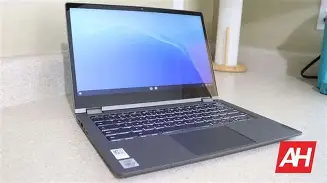
From a professional standpoint, the design of the Flex 5 2020 emphasizes utility. The chassis typically combines lightweight materials and a clean aesthetic that fits well in meetings and shared workspaces. The 360-degree hinge converts the laptop into tablet and tent modes, which is useful for presentations, referencing documents, or using touch-first apps. The footprint and thickness balance portability with a comfortable typing position; the overall impression is of a device intended for daily commuters rather than heavy-duty desk-bound users.
Display
The Flex 5 2020 commonly ships with a 13.3-inch full HD (1920 x 1080) IPS touchscreen. In practical use, this is a sweet spot for productivity: the display is large enough for split-screen multitasking yet compact for travel. Color reproduction and brightness are solid for web content, documents, and video calls, although it should not be confused with professional-grade color-accurate panels used for photo or video color grading. The touchscreen responsiveness supports Chrome OS gestures and Android app interactions smoothly, making the device useful for annotation or quick touch input in tablet mode.
Keyboard and trackpad
One of the Flex 5 2020’s strongest aspects is its keyboard. Key travel, spacing, and feedback are tuned for long typing sessions, which professionals appreciate for emails, reports, and extensive document editing. The trackpad is generally precise and supports multi-finger gestures native to Chrome OS. Both input surfaces favor everyday productivity and are comfortable for sustained use, a consideration many buyers weigh more heavily than raw CPU power.
Performance
Performance in the Flex 5 2020 reflects its design priorities. Configurations with low-power Intel processors and 4–8 GB of RAM handle web browsing, video conferencing, document editing, and light Android apps very well. The system wakes instantly and handles dozens of tabs within reason. However, tasks that rely on sustained CPU/GPU power — heavy local video encoding, advanced photo editing, or running heavy Linux development containers — will expose the platform’s limits. For users whose workflows are primarily cloud-based (web apps, remote desktops, streaming), the trade-off of lighter hardware for better battery life and lower cost is often acceptable.
Battery life and thermals
Claimed battery life for similar devices in this class ranges into the all-day territory. In real-world mixed use — web browsing, email, light video streaming, and meetings — expect practical battery life in the region of several hours beyond a standard workday edge (often 8–10 hours, variable by configuration and screen brightness). Thermals are conservative because of the low-power silicon, so the chassis rarely gets uncomfortably warm, though performance may throttle under sustained heavy loads.
Ports and expandability
Professionals often need ports. The Flex 5 2020 typically includes at least one USB-C port (used for charging and data), a USB-A port, a headphone jack, and expandable storage via microSD on some models. This set is convenient for presentations and connecting legacy accessories without forcing a dongle for every situation. The absence of an abundance of ports is a trade-off of the thin convertible design; users with multi-monitor setups or many peripherals will want a compact dock or hub.
Looking for the best Electronics deals on Amazon?
Shop Amazon →Audio, webcam, and conferencing
Webcam quality on machines of this class is serviceable for video calls and virtual meetings. Microphone performance is adequate for conference calls, though in noisy environments an external microphone or headset still improves clarity. Built-in speakers cover casual media playback and meeting audio, but professionals who rely on accurate audio for editing or client calls should use quality headphones or an external speaker.
Software, updates, and ecosystem
Chrome OS is the Flex 5 2020’s biggest strength. The operating system is fast, secure, and low-maintenance. It supports Android apps and runs Linux in a container for many developer workflows, offering a flexible environment for both productivity and light development tasks. A key buying consideration is the length of Chrome OS update support: update lifecycles are finite and device-dependent. Buyers should verify the Auto Update Expiry (AUE) for a specific unit if long-term update support is important.
Real-world use cases
Professionals will find the Flex 5 2020 well-suited to several scenarios:
Buying guide: what to prioritize
When assessing whether the Chromebook Flex 5 2020 is the right purchase, professionals should decide which trade-offs align with their workflows. Below are the most important considerations and practical advice for choosing the right configuration.
1. Memory (RAM)
For Chrome OS, RAM matters when multitasking with many browser tabs, cloud apps, and Linux containers. A device with 8 GB of RAM provides a more future-proof multitasking experience than 4 GB for a professional user. If the work involves heavy web apps, software development in containers, or many simultaneous browser tabs, choose the higher RAM option.
2. Processor
Chromebooks typically use efficient low-power CPUs. For web-first productivity and conference-heavy days, an Intel Core series configuration (when available) yields smoother performance than entry-level Celeron or ARM chips. However, users focused purely on email, word processing, and browsing can save money with lower-end options.
Looking for the best Electronics deals on Amazon?
See Deals →3. Storage
Chrome OS encourages cloud storage, so internal storage can be modest. Still, professionals who store large local files (media, large downloads, offline document sets) should prefer larger local storage (or plan to use fast external drives). If only occasional local storage is needed, a microSD slot or external SSD will suffice.
4. Display and touch
For frequent content consumption and collaborative work, a Full HD touchscreen is recommended. If color accuracy is critical (photo editing, design), consider a higher-end Chromebook or an external monitor for color-critical work.
5. Ports and connectivity
Determine how often the device will connect to external monitors, projectors, or wired networks. The presence of at least one USB-C and one USB-A port is practical for most users. If USB-C docks or multiple external displays are required, ensure the chosen configuration supports the necessary protocols or plan for a docking solution.
6. Update support (AUE)
Check the Auto Update Expiry date for the specific model before buying if long-term software support is a priority. Chrome OS update windows vary by model and release date; knowing the AUE helps set expectations for security patches and feature updates.
7. Use-case checklist
- If the primary work is cloud-based productivity (docs, email, Slack, web apps): prioritize portability, battery, and a comfortable keyboard.
- If the user needs to run Linux developer tools at scale or use heavy apps locally: consider a more powerful Chromebook or a traditional laptop.
- If the device must survive regular travel and hot desks: prioritize build quality and available port options for quick docking.
Maintenance and long-term ownership tips
Chrome OS keeps maintenance minimal, but there are small steps that extend the usefulness of the device:
- Enable automatic updates and verify the AUE to understand how long security updates will arrive.
- Use cloud storage for archives, and keep local storage for active projects to avoid clutter and performance slow-downs.
- Use a lightweight USB-C hub or dock for a stable desk setup, and keep a small protective sleeve for transit to protect the hinge and screen.
- For teams, centralize app provisioning and policies via enterprise management if the organization uses Chromebooks at scale.
Conclusion
The Chromebook Flex 5 2020 is, from a professional vantage, a balanced, practical machine that nails the essentials of a modern workday: fast startup, minimal maintenance, a comfortable keyboard, and flexible modes for different tasks. It excels for those whose workflows center on web applications, cloud services, and lightweight local tasks, and it offers a good mix of portability and screen real estate. The primary limitations are shared with many Chromebooks of its generation: modest local storage, limited raw processing power for demanding workloads, and a finite Chrome OS update window. For its intended audience — the mobile professional, educator, or casual creator seeking a responsive, low-friction device — the Flex 5 2020 remains a compelling option. Choosing the right RAM and storage configuration and verifying update support will make the difference between a satisfactory purchase and a genuinely future-proofed one.